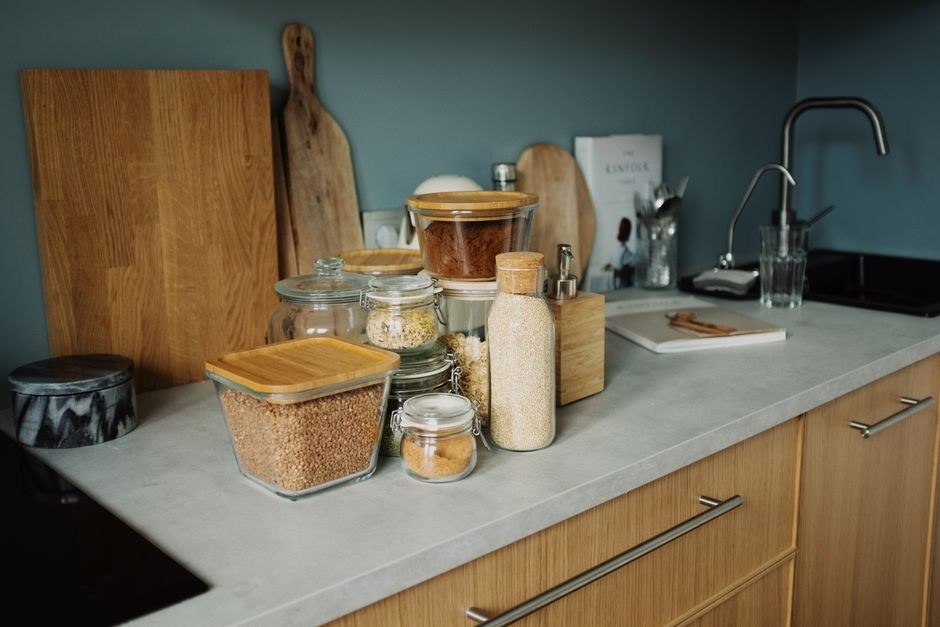
A useful kitchen counter is not necessarily a bare one. The better test is whether you can begin cooking without first moving six unrelated objects somewhere else.
Countertops tend to collect things because they are easy to reach: mail, jars, appliances, fruit, clean dishes waiting to be put away, the bottle you used once and never returned to its shelf. None of these objects is a problem by itself. The friction appears when the surface stops supporting the tasks that happen there every day.
Clear it once, then watch what comes back
Take everything off one working section of the counter and wipe it down. Do not decide immediately what deserves to return. Make dinner once or twice with the space mostly clear and notice what you repeatedly reach for.
The objects that come back naturally are often the right candidates to live there: a cutting board used every day, salt, oil, perhaps a kettle or coffee maker. The things you keep walking around with in your hand probably belong closer. The things you never miss are easier to store elsewhere.
This observation period is more useful than copying a photograph of someone else’s kitchen. A person who bakes every morning needs a different counter from someone who mostly cooks quick vegetables and pasta at night.
Create one uninterrupted work zone
Try to protect a rectangle of counter wide enough for a board and a mixing bowl. The exact size matters less than continuity. A clear surface lets you put groceries down, chop without balancing ingredients around appliances, and set a hot pan aside without improvising.
Keep the tools for that zone nearby rather than directly inside it. A small crock for the few utensils used constantly can work well. So can a drawer with a simple divider. The goal is to reduce the number of hand movements between the board, stove and sink.
If an appliance is heavy and genuinely used several times a week, leaving it out can be practical. If it appears once a month, the counter is expensive storage. Move it to a cupboard if you have one and reclaim the daily working area.
Group ingredients by action
Instead of arranging jars by how decorative they look, group them by what happens in the kitchen. Salt, pepper and cooking oil can form one small cooking group. Tea and coffee can occupy another. Bread, fruit or breakfast items can stay together if they are part of the same morning routine.
A tray is useful when it creates a boundary, not when it becomes another surface to fill. If five small bottles always move together, a tray makes sense. If the tray simply collects loose receipts and keys, it has changed the shape of the clutter without reducing it.
Finish the evening with a two-minute return
The most sustainable reset is small enough to repeat. Put the board away or stand it upright, return the oil, wipe the working zone, and move anything that belongs in another room. There is no need to make the kitchen look unused.
The reward arrives the next evening. A clear place to set down ingredients removes one small decision at the exact moment when energy may already be low. That is the real purpose of the reset: not visual perfection, but a shorter distance between deciding to cook and actually starting.